Tsavo, the railway and the man-eaters
A railway bridge, two maneless lions and red elephants: I find Tsavo’s history hard to separate from the lines that cross it.
- Country
- Kenya
- Extent
- about 22,700 sq km (both parks)
- Ground
- dry bush, lava and rivers
 CC BY-SA 4.0 — Byrdyak
In 1898, two maneless male lions killed workers building a railway bridge over the Tsavo River. I find it a grimly direct beginning to a story about people trying to cross a place that was not obliged to make crossing easy.
The line through Tsavo
Tsavo National Park was gazetted in 1948, then soon divided into Tsavo East and Tsavo West along the Mombasa road and railway. The split gives the place a neat map shape. The history is less neat: a railway crossing, a river, workers, lions. Neatness has its limits.
Tsavo East covers about 13,700 square kilometres; Tsavo West about 9,000. Together they make Kenya’s largest protected area. I like a fact that resists being held in one glance. The railway, meanwhile, keeps insisting on a line through it.
The bridge and the lions
Lieutenant-Colonel John Henry Patterson shot both lions in December 1898. He later wrote The Man-Eaters of Tsavo, published in 1907. The skins and skulls have been on display at the Field Museum in Chicago since 1925. That is a long afterlife for a pair of animals whose story began at a bridge.
Many adult male lions in Tsavo have little or no mane. The two in the railway story were maneless, but they are not an isolated detail pasted onto the park’s history. Tsavo’s lions make the old account feel less like a strange exception. The black-maned lions of the Kalahari belong to another story; Tsavo’s are notable for what is often absent.
Tsavo is not a tidy story of railway, lions and elephants, however much I would like one.
Tsavo is not a tidy story of railway, lions and elephants, however much I would like one.
East, in lava
At about 290 km, the Yatta Plateau along Tsavo East is among the world’s longest lava flows. It is a strikingly spare fact: a long flow of lava running through a park whose history is so often told through animals and rail lines. I would not try to make the land behave like a backdrop. It has its own scale.
Lugard Falls, on the Galana River, is a series of rapids through a narrow rock channel. Even the name can sound like it promises a single grand drop. The actual description is better: water moving through a tight passage, in a sequence. I prefer the less theatrical version.
 CC BY 2.0 — McKay Savage from London, UK
West, in water
Mzima Springs in Tsavo West is fed by water filtering through the Chyulu Hills and supplies part of Mombasa’s water. The sentence connects hills, springs and a city without much fuss. I like that sort of practical geography. Water does not need a plot; it has somewhere to go.
Tsavo’s terrain includes dry bush, lava and rivers. The springs and the rapids sit alongside that plain description, not in place of it. A place can be dry and still have water moving through it. I am wary of summaries that make one feature stand in for everything else.
Red elephants
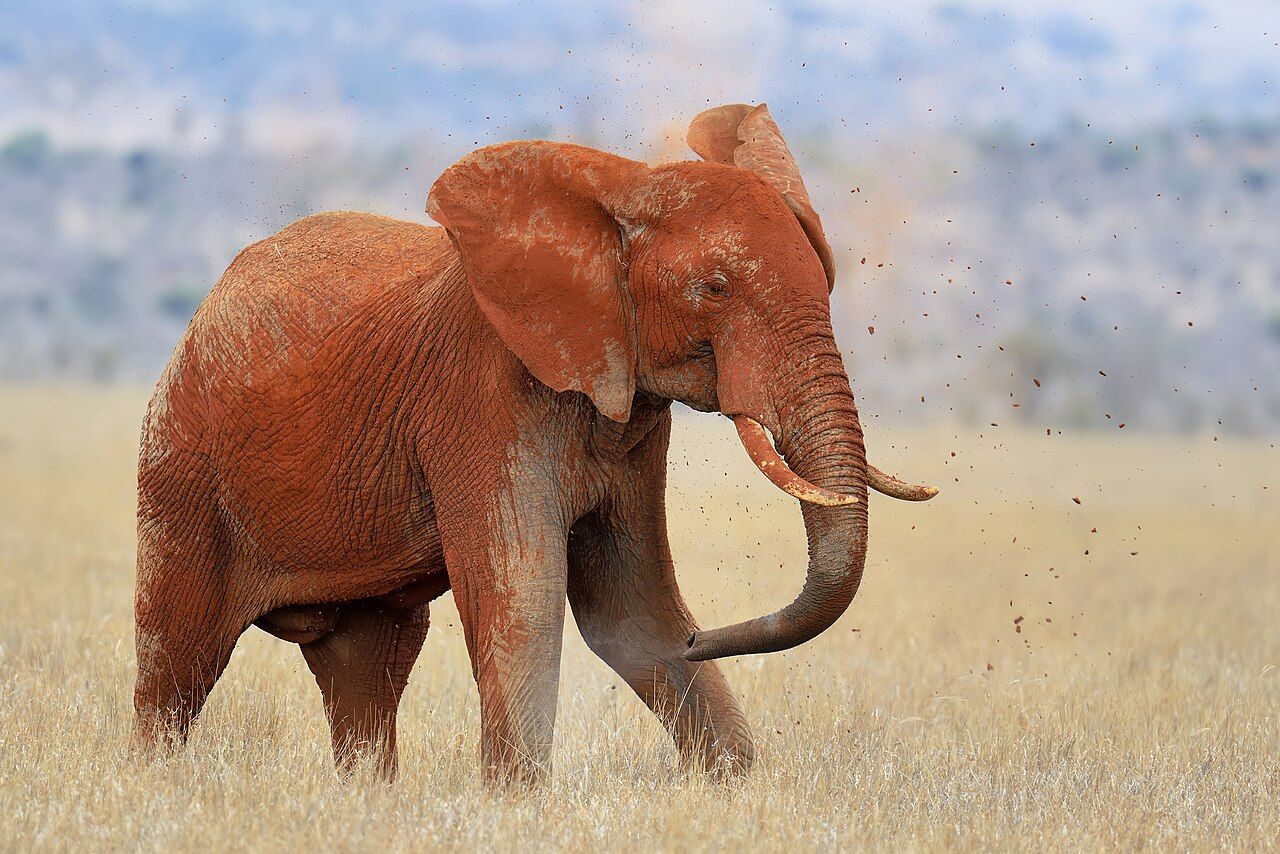
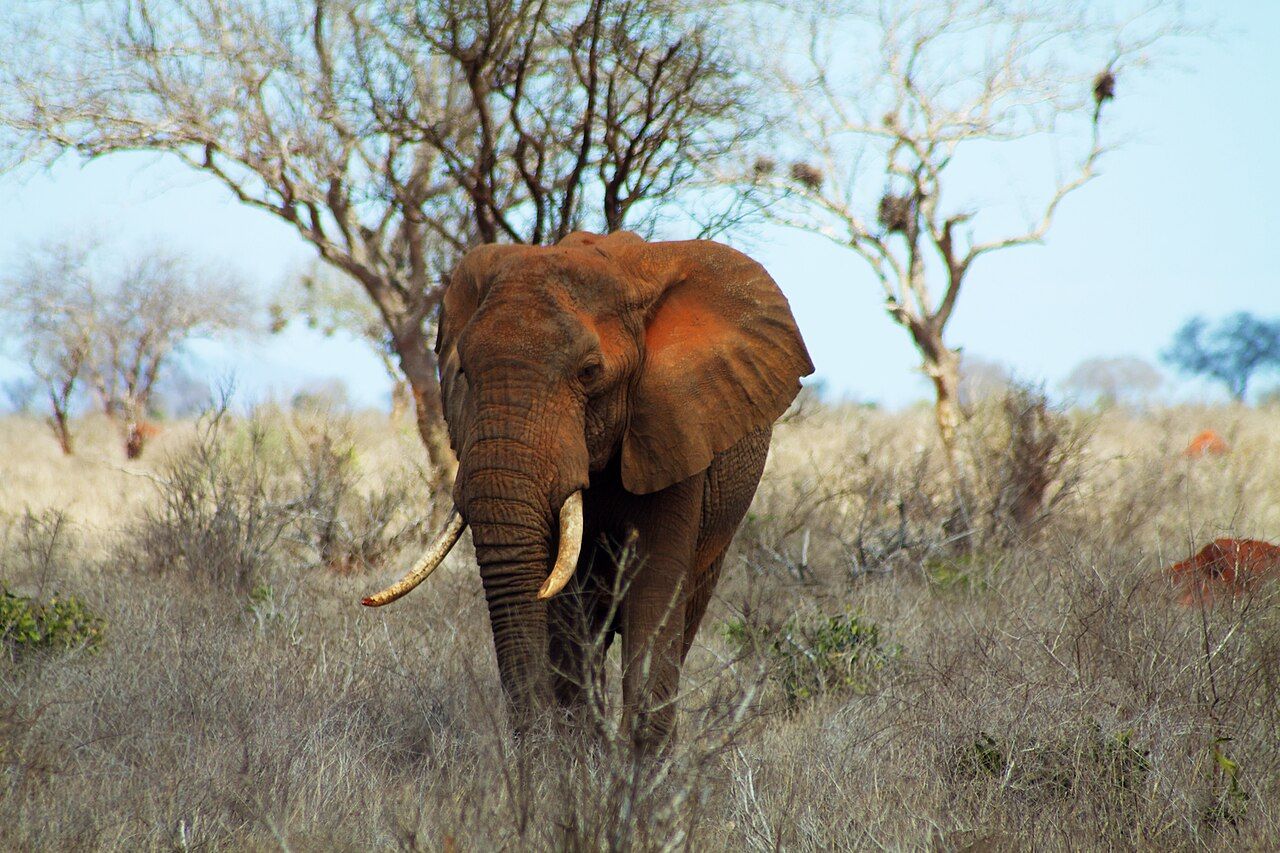
Tsavo’s elephants often look red because they dust-bathe in the region’s red soil. There is a pleasingly ordinary explanation for an appearance that might otherwise invite grander ones. Red dust on an elephant: not a mystery, just the local soil doing what it does.
The elephant population fell steeply in the 1970s and 1980s through drought and poaching. The red image does not cancel that history. It sits beside it, as the railway sits beside the lions: one part of Tsavo’s story, not a substitute for the rest. There is more on the poaching years and their answer in another story.
The newer railway
The Mombasa-Nairobi standard-gauge railway opened in 2017 and crosses Tsavo. Its raised sections are meant for wildlife to pass under. I find the design detail hard to ignore. The older railway story is remembered for a crossing where workers met lions; the newer one includes space beneath the line for animals to move through.
That is not a neat resolution, and I would distrust one. It is a practical provision built into a crossing. The railway still passes through Tsavo. The parks still hold the lava, rivers, elephants and lions that make a straight line feel like a rather confident idea. I keep coming back to that small fact: the line has to share the ground.
I would follow this with families followed for fifty years.
The numbers: Tsavo East, about 13,700 square kilometres; Tsavo West, about 9,000.