Samburu’s northern animals
Along the Ewaso Ng’iro, Samburu, Buffalo Springs and Shaba hold a memorable roster: zebra, giraffe, oryx, ostrich and the long-legged gerenuk.
- Country
- Kenya
- Extent
- about 165 sq km
- Ground
- semi-arid bush along a river
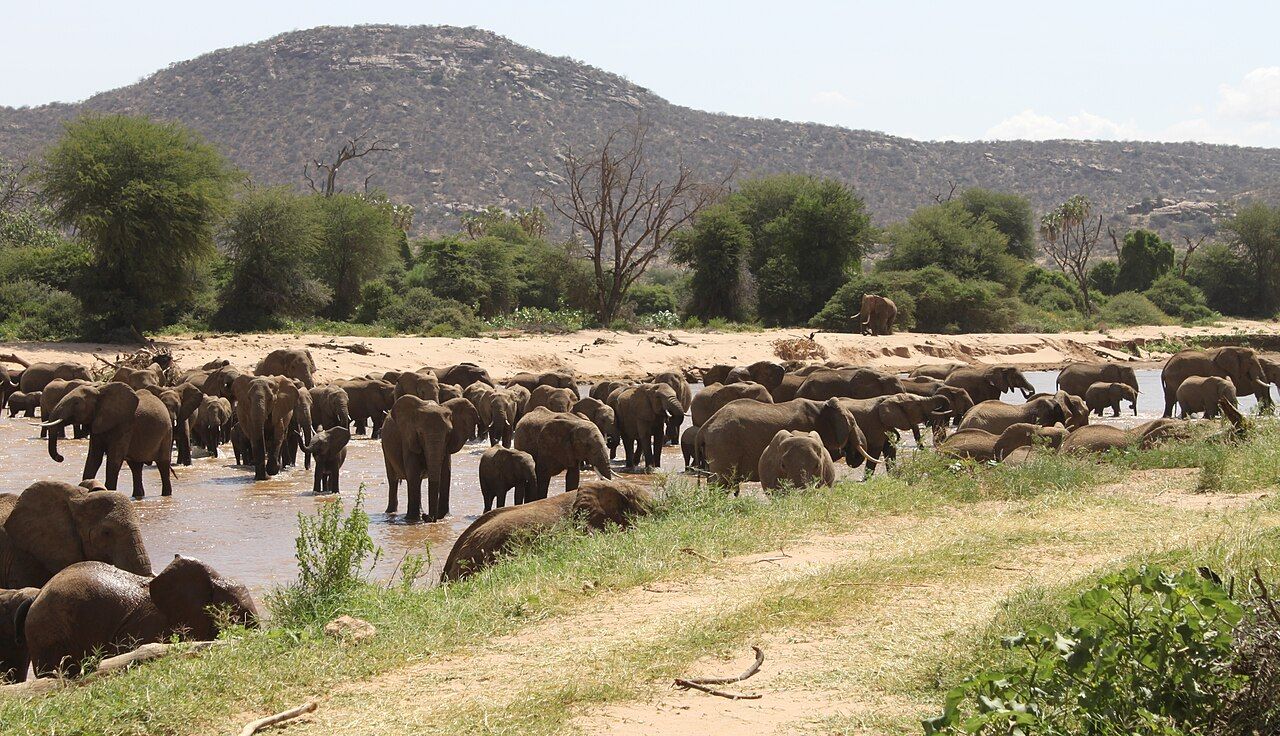 CC BY-SA 3.0 — Mark Draper Tillydad
“Brown water.”
That is the meaning of Ewaso Ng’iro in Maa. A river name that does not fuss over its image. Samburu National Reserve covers about one hundred and sixty-five square kilometres on its north bank. Buffalo Springs lies across the river on the south bank; Shaba lies to the east. The map has a clear centre of gravity.
I like that the animal story is not confined to a single reserve name. The river runs through the reserves, with doum palms lining its course. This is the useful frame for the animals: not a list floating free of place, but a group of reserves arranged around one river. Plain enough. Better than an overworked slogan.
The Samburu Special Five are Grevy’s zebra, reticulated giraffe, beisa oryx, Somali ostrich and gerenuk. Five names, each with its own small piece of distinction. I find the list more interesting when taken one animal at a time. A collective label is handy, though it does make the animals sound as if they have agreed to attend together.
Grevy’s zebra is the largest wild equid. Its stripes are narrower than those of the plains zebra. That is a neat pair of facts: size first, then the detail that separates it from the more familiar comparison. Kenya holds about nine in ten of the world’s roughly three thousand Grevy’s zebras. A large share, expressed without requiring a grand speech.
The reticulated giraffe sits in the roster beside it, named but not given an extra claim in this account. I prefer to leave that space alone rather than garnish the list with invented habits. The name itself is enough to keep it distinct here. Not every caption needs to pretend it has uncovered a secret.
The gerenuk has the clearest piece of behaviour. It stands on its hind legs to browse leaves out of reach of other antelopes. There is no need to add a tale around that. The simple action does the work, and I admit to having a strong preference for an animal whose defining detail makes the rest of the group look briefly under-equipped.
The Somali ostrich is marked out by the male’s bluish-grey skin on its neck and legs, instead of pink. A small difference in colour, but specific enough to stay in the mind. The beisa oryx completes the five. It leads naturally to oryx on another dry plain, a comparison that belongs to the animal’s name rather than any claim that every landscape tells the same story.
The river gives these neighbouring reserves their shape; the five animals give the story its names. The name Samburu also points towards the Samburu herding people. I like that reminder of people in a story often reduced to animal lists. There is also the plateau upstream to keep in mind, though here the river and its banks are enough to hold the frame.
Shaba has another name attached to its history. Joy Adamson, author of Born Free, lived there and was killed there in January 1980. I would not fold that into a wildlife caption as if it were simply another item in the roster. It is a stark fact, and it changes the tone of the place on the page.
The numbers: about one hundred and sixty-five square kilometres; Kenya holds about nine in ten of roughly three thousand Grevy’s zebras.
I’d keep the Special Five, and leave the grand claims to someone else.