Where the herds meet the Mara River
A river story, from the Mau Forest to Lake Victoria, and the repeated crossings that make the Mara more than a line on a migration map.
- Country
- Kenya / Tanzania
- Extent
- river about 395 km
- Ground
- riverine forest and open plains
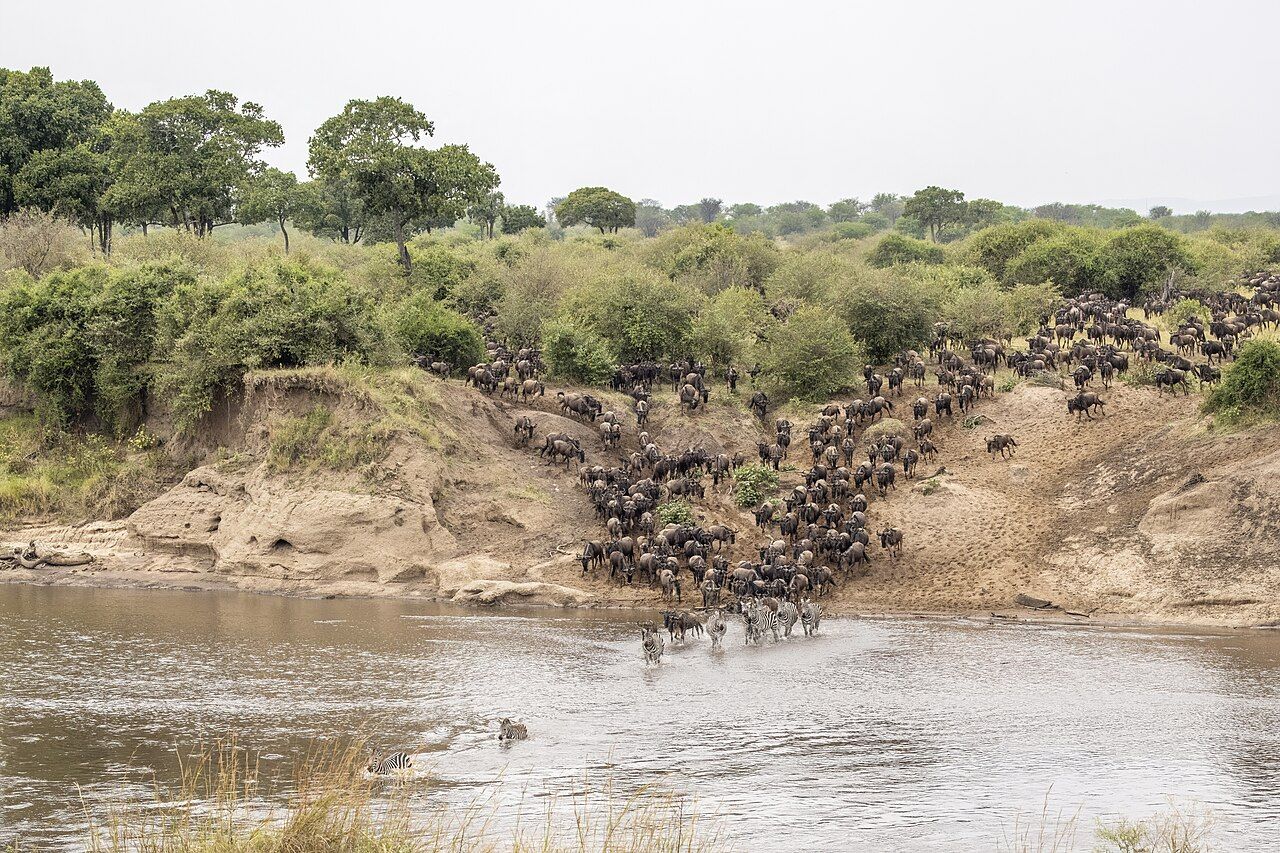 CC BY-SA 4.0 — Charles J. Sharp
I catch myself treating “the crossing” as a single event. The Mara does not make that easy. The herds gather on its banks for hours or days; then one animal jumps and the rest follow in a rush. A crossing is a moment, certainly. The waiting around it matters as well.
The river's source
I start with the river, rather than the herd. The Mara rises in Kenya’s Mau Forest and flows about 395 km to Lake Victoria, near Musoma in Tanzania. Its route passes through riverine forest and open plains. That is a long way for a body of water to go, and the migration’s annual loop keeps returning to it.
The Mara is not a stage set for a single crossing; it is the only perennial river the herds must cross on their annual loop.
The Mara is not a stage set for a single crossing; it is the only perennial river the herds must cross on their annual loop.
That word, perennial, does useful work. The herds usually reach the Kenyan side of the Mara ecosystem from about July, then drift back south into Tanzania from around October. For the migration month by month, the river is not a decorative detail between destinations. It is the one river that must be negotiated on the loop, and it is crossed more than once.
I like a map. I like it less when it makes a living movement look tidier than it is. The herds often cross the same stretch several times in a season, going back and forth as rain falls on either side. The route, on paper, may look like a decision made once. On the ground, it is a repeated adjustment. A river does not become a doorway just because a map draws a line through it.
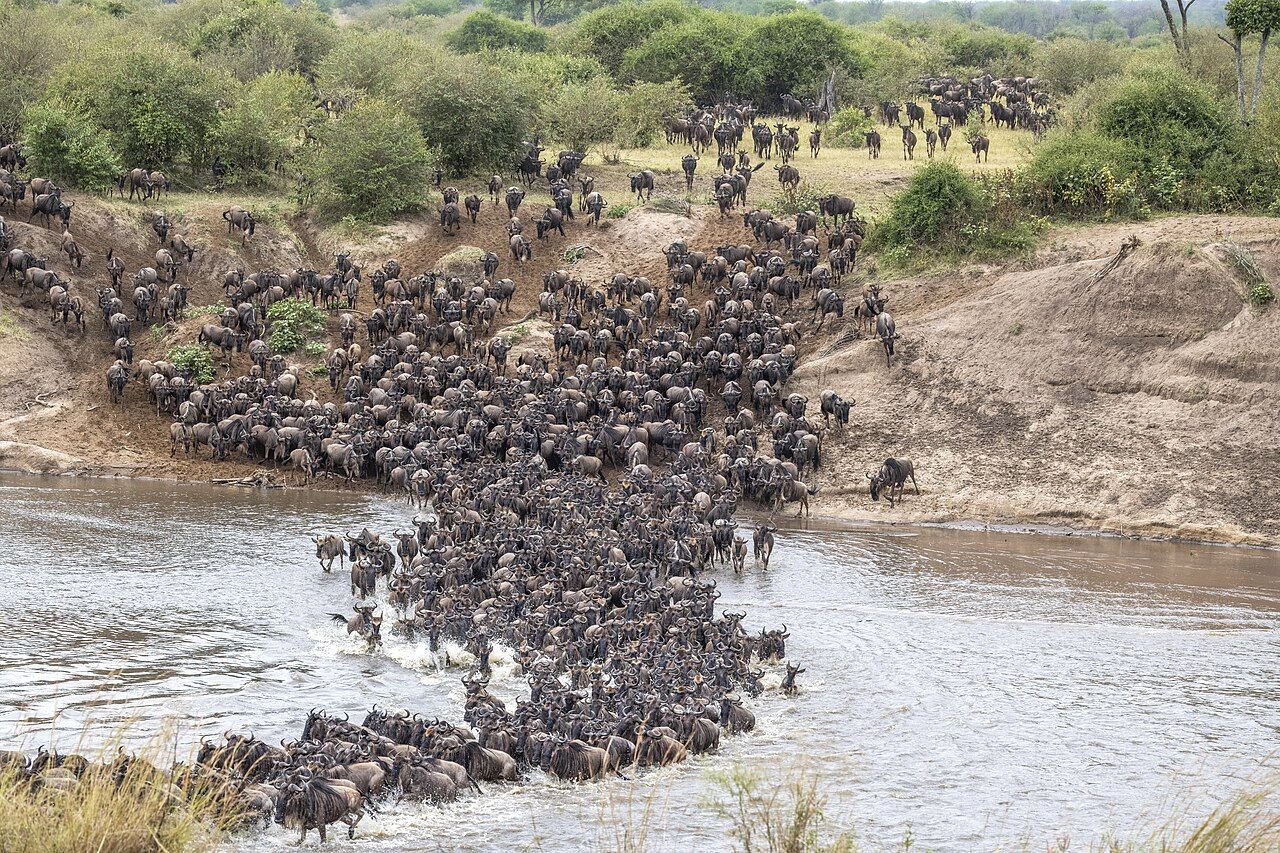 CC BY-SA 4.0 — Charles J. Sharp
As the day moves on
The waiting gathers at the banks. Hours, sometimes days. Then a single animal goes, and the herd follows in a rush. I find that sequence more compelling than the shorthand of a dramatic crossing: the pause, the sudden change, the mass of animals committing at once. The reserve’s rules require vehicles to stay back from the crossing points so the herds can reach the water. The river has enough pressure in it without a crowd pressing at the edge.
The river’s western setting has its own map; the reserve's western Triangle belongs in that wider picture. But the crossing points are where the river story tightens. Nile crocodiles there can exceed 5 m in length and take wildebeest. It is an uncomfortable part of the account, and not the whole of it. Many more wildebeest die from drowning and crushing in the press than from crocodiles. The danger is not neatly assigned to a predator. The herd itself, moving in a rush, can become the force it cannot get out of.
I have little patience for the version of the crossing that makes it only a contest between animal and crocodile. The losses continue beyond the bank. Thousands of drowned wildebeest carcasses each year release nutrients that feed fish and other river life for weeks. Death enters the river’s system as nourishment. It is a hard fact, not a reassuring one, and I would rather leave it hard.
The granite islands of the Serengeti make a different kind of river-and-land thought; here the repeated crossings keep pulling the mind back to water, pressure and return. Even the river’s own condition is not fixed. The upper Mara catchment has lost a large share of its forest cover since the 1970s, making the river’s flow less steady in dry years. The herds depend on this perennial river, while the river’s flow is shaped by what has happened in its catchment. That is a less dramatic sentence than a jump. It matters all the same.
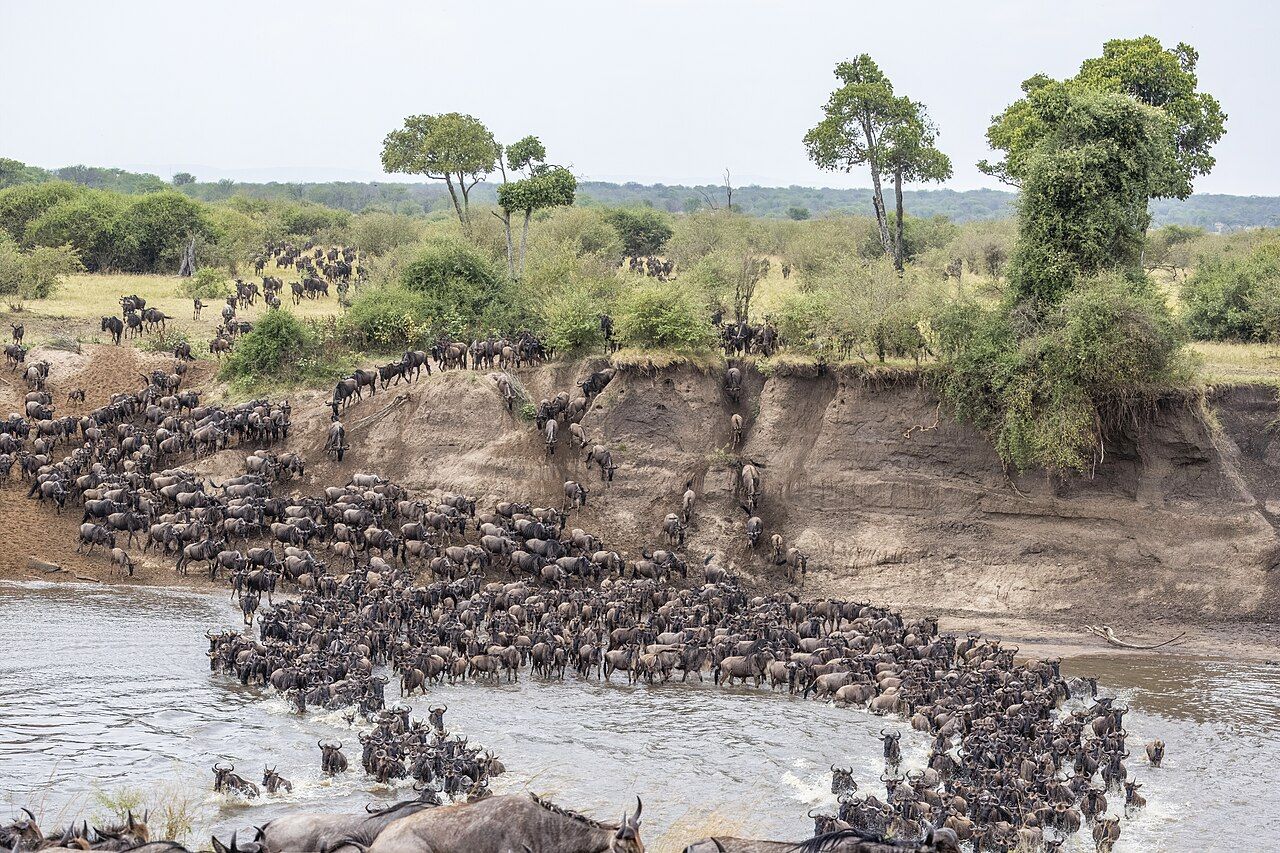 CC BY-SA 4.0 — Charles J. Sharp
Evening
At night, hippos graze on the banks. By day they crowd the deeper pools. I like this quieter counterpoint to the crossing: animals gathered in the water, then grazing at its edge, while the wildebeest story keeps moving back and forth across the same stretch. The Mara is not only a place of arrival and departure. It holds several kinds of life at once, though not always peacefully.
There are other river stories, including Zambezi tigerfish and crocodiles, but I keep this one with the Mara: a river rising in Kenya, travelling towards Tanzania, and receiving the herds again and again. Kenya’s tourism board publishes its own pages on the Mara at magicalkenya.com. Useful to know; the river itself is harder to reduce to a page.
By evening, I am less interested in the crossing as a spectacle than in its repetition. The herds wait, move, return; the river carries on, with its own pressures and consequences. I would skip the neat version of this story, where everything happens at the water’s edge and ends when the herd reaches the other bank.
The numbers: river about 395 km; herds from about July, drifting south around October; crocodiles can exceed 5 m.