The Namib’s fog-fed lives
The Atlantic’s fog feeds a spare, exacting set of lives in the Namib: beetles collecting water, welwitschia holding on, and lichen turning green.
- Country
- Namibia
- Ground
- coastal desert, dunes and gravel plains
 CC BY-SA 4.0 — Lidine Mia
“The main source of moisture for much of the coastal Namib.”
It sounds like a modest arrangement. The cold Benguela Current off Namibia’s coast cools the air and produces fog, which drifts inland over the Namib. It can reach up to about 100 km inland. For much of the coastal Namib, that fog is the main source of moisture. Not rain arriving with a grand entrance. Fog, doing its quiet work.
I like the scale of the idea: a current offshore, cooled air above it, then fog travelling inland. The foggy shore where it begins is not a separate story from the desert beyond. It is the start of the same supply line, if a supply line can be made of cloud.
A beetle with a plan
The fog-basking beetle, Onymacris unguicularis, stands head-down on dune crests. Fog condenses on its back and runs to its mouth. That is the whole method, and it has the useful quality of being difficult to improve upon. No grand apparatus. A back, a slope, a mouth.
There is a pleasingly unromantic precision to it. The beetle does not need the fog to become a lake or even a puddle. It uses what arrives on its own body. The great dunes of the Namib make the setting sound expansive; the beetle’s solution is small and exact.
Two leaves for life
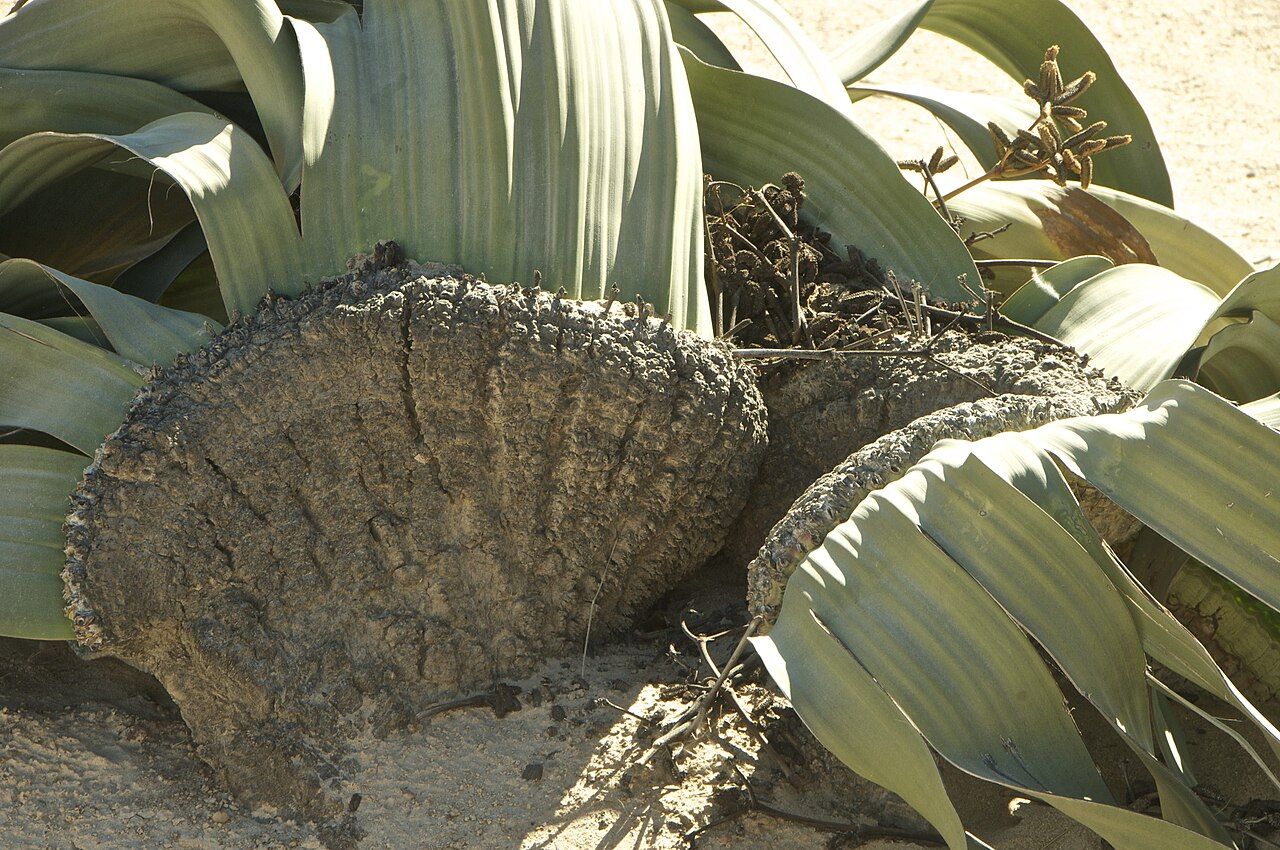
Welwitschia mirabilis grows only in the Namib Desert of Namibia and southern Angola. It grows just two leaves in its whole life. With age, they split and fray. I find that more affecting than a plant with an elaborate display. Two leaves, then the long business of remaining.
Some large welwitschias are estimated to be more than 1,000 years old. The plant is named after the Austrian botanist Friedrich Welwitsch, who described it in 1859. The name carries a person into the desert record; the plant itself seems in no hurry to do anything for an audience.
Green on the gravel
On the gravel plains near the coast, lichen fields turn green when wet with fog. It is a compact change: fog arrives, the lichens respond. I like this kind of desert fact best. Not because it makes the place sound easy, but because it makes the word “dry” feel incomplete.
The small animals have their own answers to the conditions around them. The dancing white lady spider of the Namib lives in burrows in the dunes and cartwheels away from danger. The shovel-snouted lizard lifts its feet alternately off the hot sand to cool them. One retreats with a flourish; the other changes feet. Both sound less like symbols than practical creatures getting on with it.
At Gobabeb
The Gobabeb research station in the Namib was founded in 1962 beside the Kuiseb River. Its presence gives this landscape another kind of attention: not only the lives that use fog, but the people studying them. I can see the appeal of looking closely here. The details are already doing plenty.
Fog, beetle, two leaves, green lichen, a spider turning cartwheels. The Namib does not make survival look grand. It makes it look specific. For another account of life in dry country, there are the elephants in dry country.
The numbers: fog can reach about 100 km inland; some large welwitschias are estimated at more than 1,000 years old; Gobabeb was founded in 1962.