Fort Namutoni and the spring that started it
A spring put Fort Namutoni on Etosha’s eastern side; its brief battle, rebuilding and later life as a monument make a spare history.
- Country
- Namibia
- Ground
- historic fort beside a spring
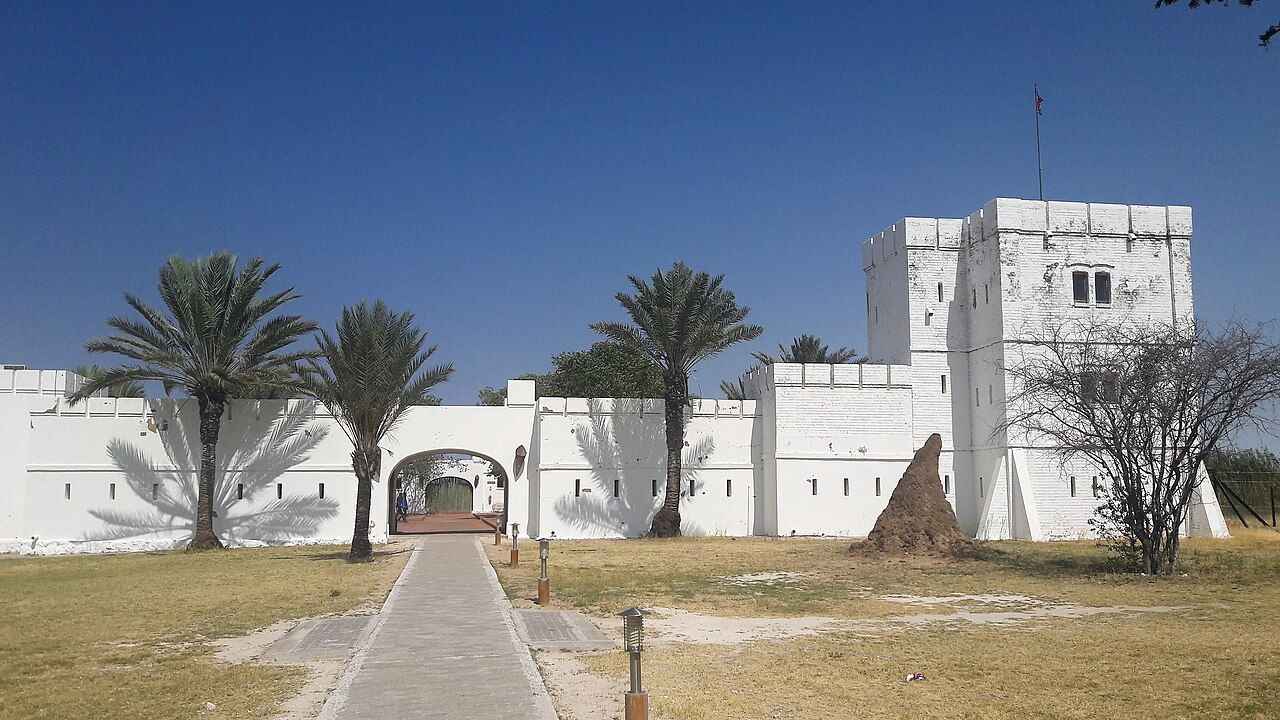 CC BY-SA 4.0 — Jedesto
I have a weakness for histories that begin with an unshowy fact: a spring. It was the reason Fort Namutoni was built here, and it is a better opening than any grand claim about strategy. In the morning, I start there. Water, then a post. A tidy beginning, though the history does not stay tidy.
Namutoni lies near the King Nehale gate and the Von Lindequist gate, on Etosha’s eastern side. The fort was built as a German police and military post in the early 1900s. I turn from that practical beginning to the pan beyond the fort walls in pan beyond the fort walls. The thought is a useful change of scale; the fort, meanwhile, keeps its own account of the place.
By afternoon, the date is 28 January 1904. A force of several hundred Ndonga warriors attacked Namutoni, held by seven German soldiers. The defenders slipped away during the night, and the fort was destroyed. There is no polished heroism in the sequence. An attack, an escape, a ruined post. Walls are not, as it turns out, a complete plan.
The rebuilding came in 1906. Fort Namutoni later served as a police post, before being declared a national monument in 1950. That progression has little ceremony: a post built because of a spring, then destroyed, rebuilt, and given a different kind of purpose. The word “monument” can make a place sound settled. This one had to be put back together first.
By evening, I am turning over the name. Namutoni comes from an Oshiwambo name for the place, often given as “high place that can be seen from afar”. It is a phrase with a view built into it. My own thoughts return instead to the spring, which is less grand and rather more persuasive. For another monument, I think of a Portuguese stone cross.
The numbers: 28 January 1904, 1906 and 1950; for another story, I’d go to old stone walls in Kruger.